The Great Pirates
The Hidden Architecture of Systemic Control
Buckminster Fuller identified a pattern that has shaped human civilization for centuries. A historical and modern analysis of power, revealing how sophisticated architects maintain control through information asymmetry, debt, and the intentional creation of specialized ignorance.
Fuller's Great Pirates analysis is not just intellectual history — it's a revelation that demands an emotional response. This original song captures that moment of recognition: the anger, the clarity, and ultimately the defiance of a crew that has finally seen the system.

Ballad of the Great Pirates
by delanofoods · 3:21
"They drew the maps, they named the stars — they built the invisible iron bars!"View on Suno
The Antidote: Seeing the Whole Picture
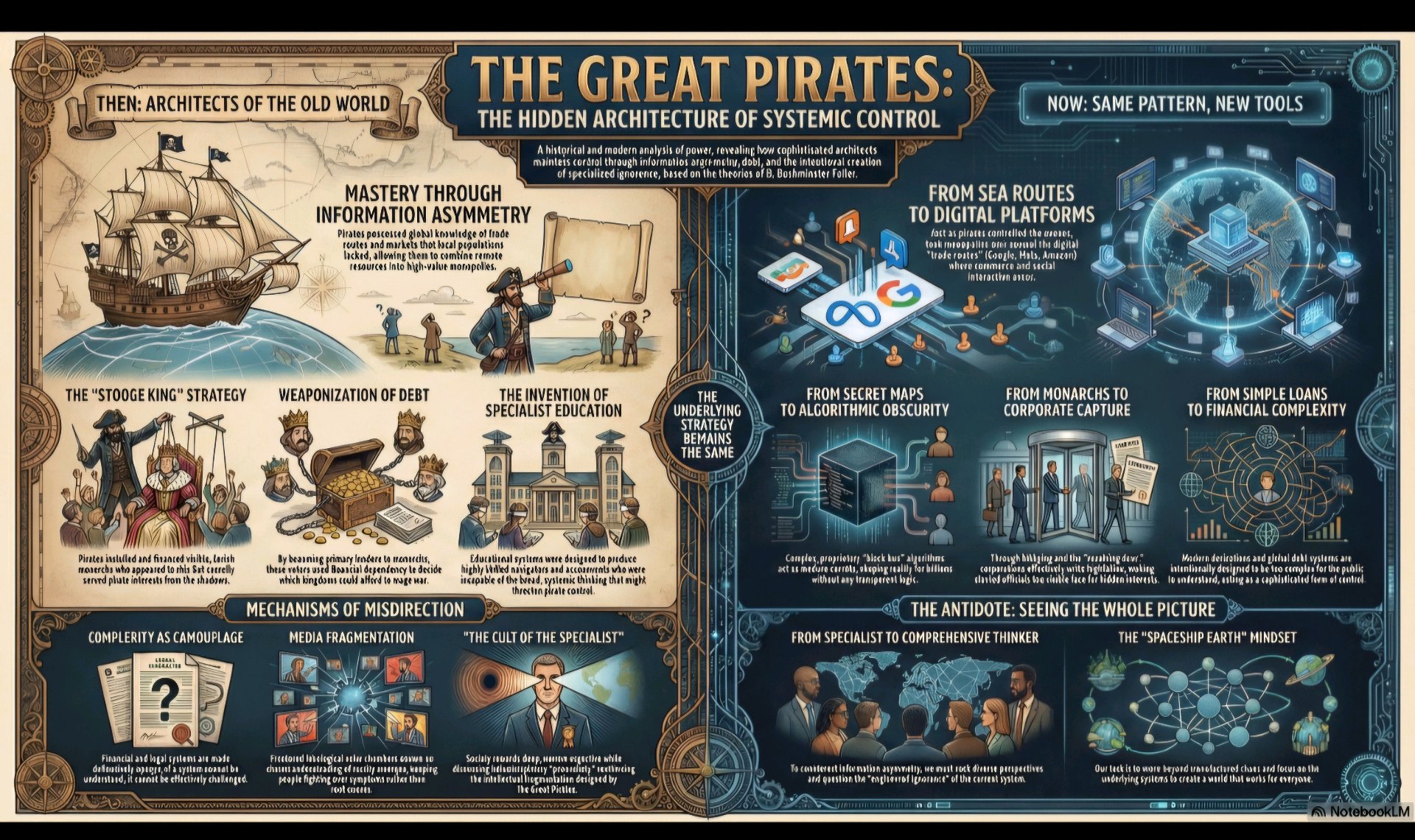
Fuller's response to the Great Pirates was not revolution—it was comprehension. He believed that if enough people could develop the comprehensive, anticipatory thinking that the pirates had monopolized, the entire system of control would become obsolete. You cannot manipulate someone who can see the whole board.
This is the mission of CADSI and the ImaginEngineers podcast: to develop the comprehensive thinkers that Fuller believed were humanity's only hope. Not specialists who know everything about one thing, but generalists who understand how everything connects to everything else.
Then & Now: The Same Pattern, New Tools
Mastery Through Information Asymmetry
The Great Pirates possessed comprehensive knowledge of global trade routes, resource locations, and market conditions that local populations entirely lacked. This information gap was not accidental—it was carefully cultivated and protected. By knowing what others didn't, they could combine remote resources into high-value monopolies, appearing as benefactors while extracting enormous wealth.
Today's tech monopolies (Google, Meta, Amazon) control the digital 'trade routes' where commerce and social interaction occur. They possess comprehensive data about human behavior, preferences, and vulnerabilities that individuals and governments cannot match—the same asymmetry, new medium.
The 'Stooge King' Strategy
Pirates installed and financed visible monarchs who appeared to rule but secretly served pirate interests. These 'stooge kings' provided legitimacy and absorbed public anger while the actual power remained hidden. The monarch was the face; the pirate was the hand.
Through lobbying, campaign finance, and the revolving door between industry and government, corporations effectively write legislation while elected officials serve as the visible face of power. The politician is the stooge king; the corporate interest is the pirate.
The Weaponization of Debt
By becoming primary lenders to monarchs, pirates used financial dependency to decide which kingdoms could afford to wage war, fund exploration, or resist pirate control. Debt was not merely financial—it was a leash.
Modern derivatives, global debt systems, and financial complexity are intentionally designed to be too complex for the public to understand. Student debt, national debt, and corporate debt structures create the same dependency that medieval monarchs experienced—a sophisticated, updated form of control.
The Invention of Specialist Education
Educational systems were deliberately designed to produce highly skilled navigators and accountants who were incapable of the broad, systemic thinking that might threaten pirate control. Specialization was a feature, not a bug—it prevented anyone from seeing the whole picture.
Our education system continues to reward deep specialization while systematically discouraging interdisciplinary, comprehensive thinking. We produce excellent engineers, lawyers, and doctors who cannot connect their work to the larger systems they operate within—exactly as designed.
Mechanisms of Misdirection
Complexity as camouflage, media fragmentation, and the 'cult of the specialist' work together to keep populations focused on symptoms rather than systems. Financial and legal systems are made deliberately opaque; a system you cannot understand cannot be effectively challenged.
Fractured ideological echo chambers keep us discussing surface-level symptoms, keeping people fighting over socially divisive issues rather than root causes. The media profits from outrage and division, not from the comprehensive understanding that would threaten existing power structures.
"You never change things by fighting the existing reality. To change something, build a new model that makes the existing model obsolete."— R. Buckminster Fuller
Understanding the Great Pirates can feel overwhelming. But Fuller's answer was not despair — it was the trim tab. One person, in the right place, with the right leverage, can change the direction of the whole ship. This waltz is for you.

The Trim Tab Waltz
by delanofoods · 4:33
"A tiny rudder on the back of the big one — that's all it takes to turn the ship around."View on Suno